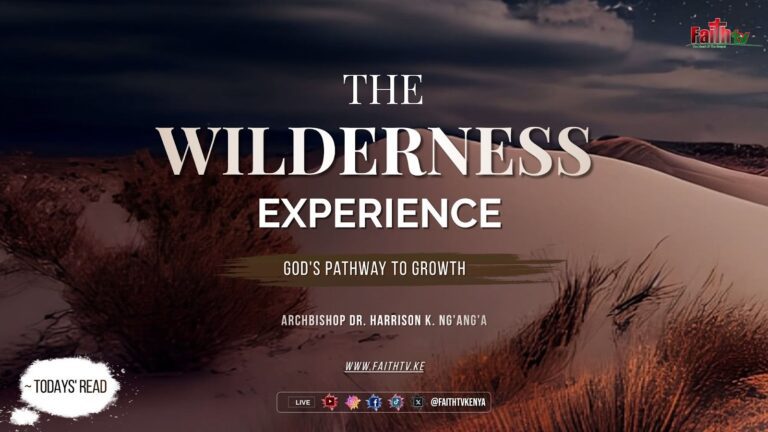
Every believer, at one point or another, must walk through the wilderness. It is a place of testing, misunderstanding, and deep loneliness. Yet it is also the place where God anchors our souls more firmly in Him. No classroom or sermon alone can teach what the wilderness reveals. It strips away pride, silences distractions, and lays us bare before the Lord. And it is there, in weakness, that His strength shines the brightest.
Paul echoed this truth when he wrote in 2 Corinthians 12:9: “My grace is sufficient for thee: for my strength is made perfect in weakness.” In your weakest hour, God’s strength is most visible.
Finding God’s Presence in the Valley
I could not explain what was happening in my life. My shoes had holes, my clothes were worn out, and even friends avoided me in broad daylight. Shame became my companion.
One day, I went to a relative’s shop. The place was crowded, but when people saw me, they stepped aside and gave way. I felt honoured, bought my milk and bread, and left. Later, I asked why. My relative replied: “They thought you were mad. They were surprised you spoke like a normal person.”
The honour was not respect—it was pity. They assumed I had lost my mind. That is how far my wilderness had taken me.
With no one else to turn to, I gave myself to prayer. Days in the forest, nights on my knees, interceding even for people I had never met. At times, the Spirit carried me in visions to distant places so I could pray that their faith would not fail.
Though the world misjudged me, heaven drew me close. In my wilderness, visions and dreams came alive. The pain was real, but so was God’s presence. The wilderness became not just a place of breaking, but also of divine visitation.
Paul captures this mystery in Romans 5:3-5: “And not only so, but we glory in tribulations also: knowing that tribulation worketh patience; and patience, experience; and experience, hope: and hope maketh not ashamed; because the love of God is shed abroad in our hearts by the Holy Ghost which is given unto us.”
This verse outlines the process that every wilderness season teaches us. The four steps are interrelated and interdependent, each leading to the next: tribulation gives rise to patience, patience builds experience, experience fosters hope, and hope dispels shame. What once felt like humiliation becomes a testimony of His love.
The world may misunderstand you, but God is using the valley to shape you. And the hope He plants within you will never leave you ashamed. The wilderness may break us down, but through this process, God is quietly building us up. By His Spirit, tribulation becomes hope, and hope never disappoints.
Brethren, we endure the wilderness not by our might but by His grace. What looks like weakness becomes the stage for His power. What feels like rejection is actually preparation. And what once seemed like shame becomes the anchor of your testimony.